
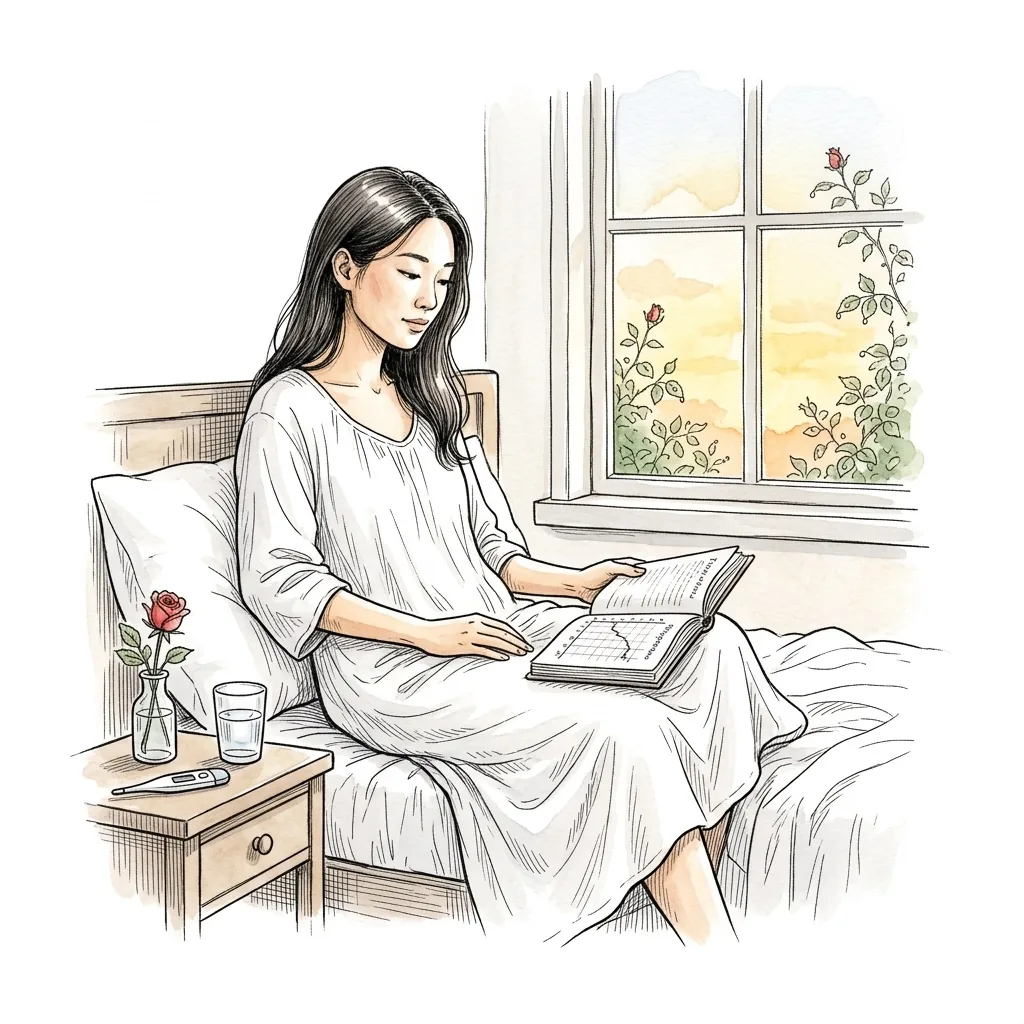
How to chart your cycle by hand, and what to bring to your provider
Dear one,
When a patient tells me “my periods have been weird lately”, my first question is always the same: Can you show me? The women who can are the ones who get answers fastest. A simple period tracker printable, filled in one day at a time, is one of the most useful things you can bring to any appointment about your body.
It’s also one of the most private. Here’s how to use our free trackers, what the codes mean, and why I’d choose paper over an app every time.
Why keep a paper period tracker?
It’s private. Your cycle dates, your symptoms, whether you might be pregnant: this is some of the most sensitive information you have. A paper period tracker can’t be hacked, sold or breached. It doesn’t share with advertisers, and it doesn’t vanish when a company changes its terms or shuts down. I’ve written the full story of period apps and privacy in Why the Womb Journal Lives on Paper, so I’ll leave it there.
It slows you down. An app asks you to tap a button. A page asks you to notice. When you write “C” for cramps by hand, you pause long enough to ask what your body is telling you.
It shows you the whole year at once. One glance at a full year on a single page can reveal patterns a scrolling screen hides: the headaches that always come on day 26, the cycles that grow longer every winter.
It speaks your provider’s language. A clear chart on paper is easy to hand across the desk.
The Yearly Period Tracker: how to use it
The Yearly Period Tracker in our free Starter Kit is a single page: one row for each month, January to December, with a box for each date from 1 to 31, and a column at the end for cycle length. There’s an example row at the top to show you how it looks filled in.
Your provider likely isn’t trained in moon phases, so this page speaks their language instead.
1. Flow: circle the letter
On each day you bleed, circle a letter for how heavy it is:
| Code | Flow |
|---|---|
| S | Spot |
| L | Light |
| Md | Medium |
| H | Heavy |
Spotting counts. Note it, even if it’s just a trace on the tissue. Spotting before your period, between periods or after sex is useful information.
2. Cervical mucus: write the letters
Your cervical mucus (or cervical fluid) changes across your cycle, and it’s one of the clearest signs of where you are. Check it when you use the bathroom, on the tissue or your underwear.
| Code | Mucus | What it often means |
|---|---|---|
| D | Dry | Little or nothing. Common right after your bleed and after ovulation. |
| St | Sticky | Thick, tacky, breaks apart. Fertility rising. |
| Cr | Creamy | Smooth, lotion-like, white or cloudy. Nearing ovulation. |
| EW | Egg-white | Clear, slippery and stretchy, like raw egg white. Your most fertile days. |
Over a few months, you’ll start to see your own pattern: dry, sticky, creamy, egg-white, then dry again.
3. Symptoms: write the letter
Write symptom letters in the box for that day:
| Code | Symptom |
|---|---|
| C | Cramps |
| B | Bloating |
| F | Fatigue |
| H | Headache |
| A | Acne |
| T | Tender breasts |
| Ms | Mood shift |
| L | Low energy |
| CL | Clots |
| X | Bleeding between periods |
More than one? Write them together, like C/H for cramps and a headache.
A small tip: L and H appear twice, once for flow and once as symptoms. Circled letters are flow. Written letters are symptoms. That’s all you need to keep them apart.
4. Cycle length: count at the end of the row
Cycle length is the number of days from the first day of one bleed to the day before the next. So if your period starts on March 3 and your next one starts on March 31, your cycle was 28 days (March 3 to March 30). Write it in the last column.
Day 1 is the first day of real flow, not spotting. If you’re not sure, choose one rule and use it every time. Consistency matters more than perfection.
The Moon Cycle Tracker: your body beside the moon
The Yearly Period Tracker speaks to your provider. The Moon Cycle Tracker speaks to you.
It’s laid out like a calendar, Sunday to Saturday, with a box for each day of your cycle. There’s one filled-in example and one blank to print.
- Write Day 1 in the first row, under its day of the week. If you bleed, Day 1 is the first day of your bleed, whatever the moon is doing. If you don’t, start on the next new moon.
- Write in each real date as you go, and keep going, even into the next month.
- Mark the moon’s phase each day (new, waxing, full or waning) using any moon calendar or almanac.
- Mark your bleed and ovulation with the symbols on the page: when your period starts and ends, your bleed days, and your ovulation day if you know it.
- At the end of the cycle, fill in your summary: how long your period lasted, the name of that month’s full moon, the day you ovulated, the season you felt most, and your feminine life stage right now (Maiden, Queen, Mother, Healer or Wise Woman).
Over three cycles, you’ll see whether you bleed with the new moon or the full moon, or somewhere between. (Learn what that means in Red Moon vs White Moon Cycle.) And you’ll start to feel your own four inner seasons, which I’ve described in The Four Inner Seasons of Your Cycle.
What to bring to your healthcare provider
Bring your Yearly Period Tracker, and if you can, two or three cycles of notes. Your provider will usually want to know:
- The first day of your last period (and the ones before it)
- Your usual cycle length, and how much it varies
- How many days you bleed, and how heavy your flow is
- Any spotting or bleeding between periods or after sex
- Your symptoms, and which days of the cycle they appear
- Any medications or supplements, including hormonal contraception
That’s exactly what the tracker is built to show.
Signs that warrant a visit
Please book an appointment with your healthcare provider if you notice:
- Very heavy bleeding: soaking through a pad or tampon every hour or two for several hours, waking at night to change it, or passing clots larger than about a quarter (roughly 2.5 cm)
- Bleeding longer than seven days
- Cycles regularly shorter than 21 days or longer than 35 days
- Skipped periods when you aren’t pregnant, or periods that stop
- Bleeding between periods, after sex, or after menopause (any bleeding after menopause should always be checked)
- Pain that stops your life, or that’s getting worse
- Mood changes that disrupt your work or relationships in the days before your bleed
- A sudden change from what’s normal for you
- Signs of anemia, like unusual tiredness, shortness of breath or dizziness, especially with heavy periods
And if you’ve been trying to conceive for a year (or six months if you’re 35 or older), it’s time to talk.
Seek urgent care for very heavy bleeding with dizziness or fainting, or sudden severe pelvic pain.
From period tracker to period journal
A tracker records what happened. A period journal asks what it meant. When you’re ready to go deeper, a cycle tracking journal lets you write beside the data: how you felt, what you dreamed, what your body was asking for.
That’s what The Womb Journal is. It holds three cycles of guided daily pages (93 days, each with a physical and emotional check-in, a spiritual practice page and an open Creation Page), a womb prompt and an affirmation for every day, and a full set of charts to bring to your provider: moon cycle, yearly period, perimenopause and menopause, fertility, IVF milestones, and a medication log. All on paper, on purpose. What you write belongs to no one but you.
If you’re tracking because your cycle is changing in your forties or beyond, read A Perimenopause Tracker, and join the waitlist for our perimenopause and menopause volume at /books/.
Why do this on paper?
Your cycle, your rituals and your body’s story deserve better than an app that sells them. The Womb Journal lives on paper, on purpose: it can’t be hacked, sold or breached. What you write belongs to no one but you.
Begin tonight
Your free Womb Journal Starter Kit holds the Four Seasons at a Glance, a Moon Cycle Tracker, a Yearly Period Tracker to bring to your provider, the Homecoming ritual and the Womb Journal Vow. Print it and begin your practice tonight.
The Womb Journal is the whole path: three full cycles of guided daily pages, more than 30 rituals, and a womb prompt and affirmation for every day.
Held with care: this teaching is for reflection and self-knowledge. It isn’t medical advice. If something in your body worries you, please talk to your healthcare provider. Health disclaimer