Why the moon turns red, what it has meant to women through the ages, and the Blood Moon you carry within
Dear one,
There are two blood moons in a woman’s life. One rises in the sky a few times a decade where you live, when the full moon slips into Earth’s shadow and glows the colour of embers. The other arrives in your own body, month after month, every time you bleed.
When women search for the blood moon meaning, they’re usually asking about the first. In The Womb Journal, I want you to know the second just as well. Let’s look at both: the science (because I’m a nurse, and you deserve the facts) and the spirit (because I’m a mystic, and facts are not the whole story).
What is a blood moon? The science
A blood moon is the popular name for a total lunar eclipse.
Here’s what happens. The sun, Earth and moon line up, with Earth in the middle. Earth blocks the sun’s direct light from reaching the moon, and the moon passes into the darkest part of Earth’s shadow (astronomers call it the umbra).
You might expect the moon to disappear. Instead, she turns copper, rust or deep red. Why?
Because Earth has an atmosphere. As sunlight passes through the thin ring of air around our planet, the air bends (refracts) some of that light into the shadow and toward the moon. Along the way, the blue light is scattered out, the same reason our sky is blue, and the reds and oranges travel on. In a sense, the moon is lit by every sunrise and sunset happening on Earth at that moment.
A few more true and lovely things:
- A lunar eclipse can only happen at a full moon, because that’s the only time the moon sits opposite the sun.
- The colour changes from eclipse to eclipse. Dust, cloud and volcanic ash in Earth’s atmosphere can make the moon bright orange one time and a deep, dusky red the next.
- It’s safe to watch with your bare eyes. Unlike a solar eclipse, you need no special glasses. Binoculars make it even more beautiful.
- Totality can last from a few minutes to well over an hour, and anyone on the night side of Earth can see it, weather permitting.
- They’re not rare, but they’re not common either. Some years bring two total lunar eclipses, some bring none, and whether you can see one depends on where you live.
To find the next blood moon visible from your home, check an eclipse calendar from a space agency, an observatory or your local astronomy club.
Other “blood moons”
The name is used loosely too, which causes some confusion:
- The Hunter’s Moon. In some traditions the October full moon (the one after the Harvest Moon) is called the Blood Moon, perhaps for the autumn hunt, or for its orange glow as it rises.
- Any moon low on the horizon. When the moon rises or sets, you’re seeing her through more of Earth’s atmosphere, which can turn her orange or reddish for a little while. That’s real, but it isn’t an eclipse.
- The “blood moon tetrad.” In 2014 and 2015, four total lunar eclipses fell in a row, and some predicted great upheaval. The sky put on a beautiful show, and the world carried on.
The blood moon spiritual meaning
For as long as people have looked up, a red moon has stirred something. In many ancient cultures, eclipses were read as omens and met with ritual, noise, prayer or fasting. Even now, when we know exactly why it happens, many of us feel it: the strange hush when the bright full moon dims and reddens.
In modern moon wisdom, the blood moon spiritual meaning often gathers around a few themes:
- Revelation. A full moon already brings things into the light. An eclipse, with its shadow passing across that light, is often seen as a time when what was hidden comes to the surface.
- Endings and release. The full moon is a natural time for letting go. An eclipsed full moon is felt as letting go turned up: a door closing so another can open.
- Shadow work. The moon literally walks through a shadow. It’s a natural night to look gently at the parts of yourself you usually keep in the dark.
- Rebirth. Every eclipse ends. The moon always comes back to her full, silver self. That’s the quiet promise of the night.
I’ll be honest with you: there’s no evidence that an eclipse changes your body, your mood or your fate. But a night that makes thousands of people step outside and look up together is a sacred thing in itself. You can let it mean something.
Your Blood Moon: the other meaning
Long before anyone explained refraction, women knew the moon and the bleed belonged together. Our cycles often run close to the moon’s 29.5 days, and many traditions called a woman’s period her “moon time”.
In The Womb Journal, the Blood Moon also means your bleed. Your period isn’t treated as an inconvenience to manage, but as a monthly message from your body, and the book teaches you how to receive it. It calls this reading your Blood Moon.
Your bleed is your inner Winter, the season of release and deep listening, matched with the dark new moon. (If you bleed at the full moon instead, you may be in what moon wisdom calls a Red Moon cycle. I’ve written about that in Red Moon vs White Moon Cycle.)
What a nurse notices in a bleed
Reading your Blood Moon begins with simply noticing, without judgment:
- Timing. When did it come? Is it close to when you expected?
- Length. How many days? Most periods last between two and seven.
- Flow. Spotting, light, medium or heavy, and how it changed day by day.
- Colour. Bright red is usually fresh, steady flow. Darker red or brown is often older blood, common at the start or end. Pink can be a lighter flow.
- Clots. Small clots on heavier days are common.
- How you feel. Your energy, your mood, your dreams, what you’re craving and what you’re ready to release.
Please talk to your healthcare provider if you’re soaking through a pad or tampon every hour or two for several hours, passing clots larger than about a quarter (roughly 2.5 cm), bleeding longer than seven days, bleeding between periods or after sex, or if pain stops your life. Those aren’t messages to sit with quietly. They’re messages to share with someone who can help.
A gentle blood moon ritual
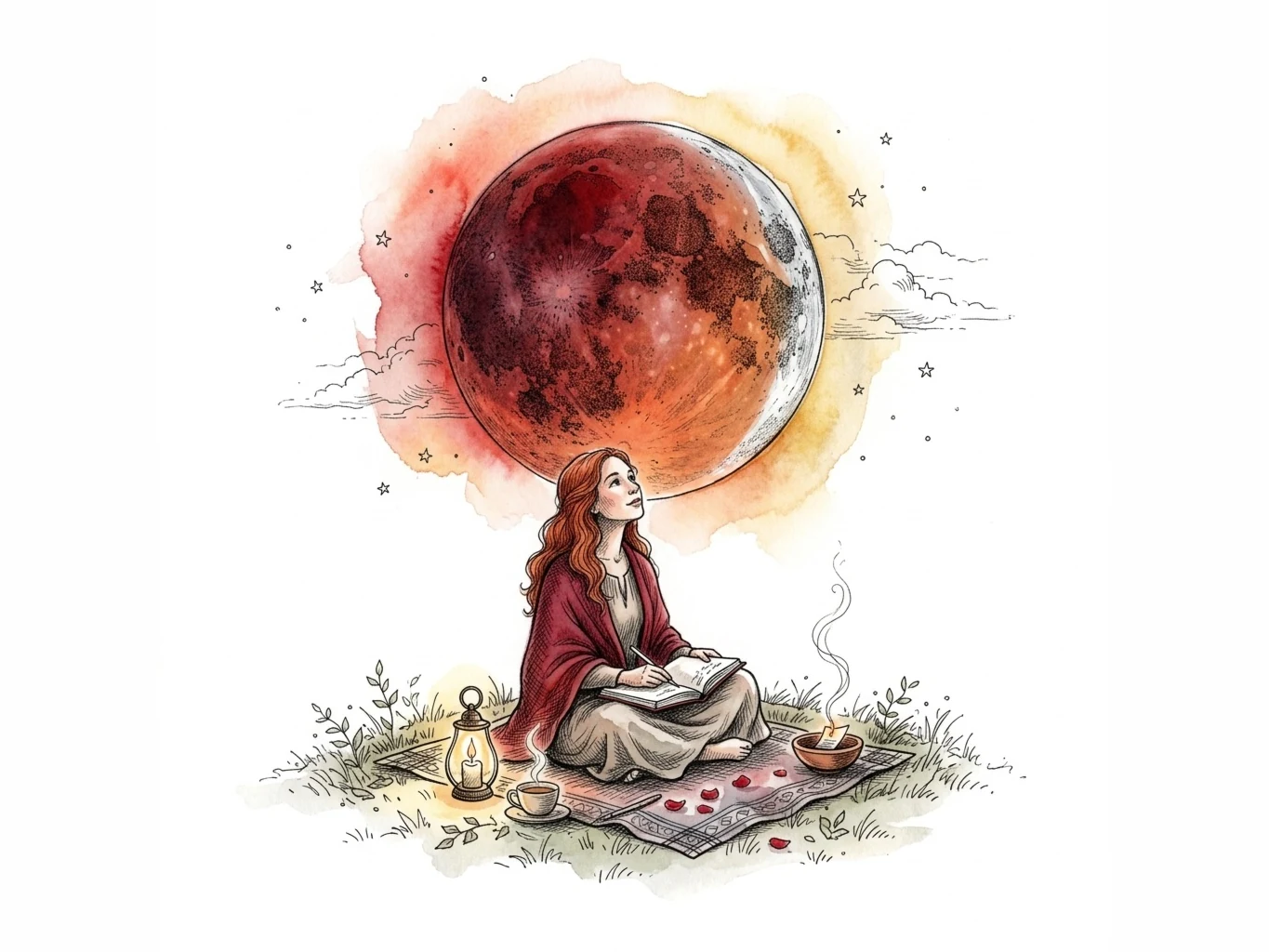
You can do this ritual on the night of a total lunar eclipse, or on the first night of your own Blood Moon. Or both. It takes about twenty minutes.
You’ll need: a candle, a pen and paper (or your Womb Journal), a cup of something warm, and a blanket. Something red is lovely: a cloth, a flower, a stone.
- Arrive. Light your candle and wrap yourself in the blanket. Rest both hands on your lower belly and take ten slow breaths into your pelvis, letting each exhale soften it.
- Greet the red moon. If it’s an eclipse night and you can see the sky, watch the shadow creep across the moon. If it’s your own bleed, close your eyes and picture her glowing deep red. Say, silently or aloud: “I honour the dark that comes before the light.”
- Listen. Ask your womb: “What are you releasing this cycle? What do you want me to know?” Pause after each question. Notice any sensation, image or word, without judging it.
- Write. Answer this prompt from the book’s Winter season: What is my body asking me to release this cycle? Then write what you noticed in your bleed, if you’re bleeding: the colour, the flow, how you feel.
- Release. Choose one thing you’re ready to let go of. Write it on a small piece of paper. Tear it slowly into pieces, or (safely) let it burn in a fireproof bowl, and say: “I release you with thanks.”
- Receive. Drink your warm cup slowly. Know that the light always returns.
- Close. Rest one hand on your womb. Thank the moon and thank your body. Take three deep breaths and blow out the candle.
On an eclipse night, you might stay up to watch the moon return to silver. On your own Blood Moon, go to bed early. Rest is part of the ritual.
For more release practices, see A Full Moon Release Ritual or Full Moon Rituals for Beginners.
Keep a record of your Blood Moons
One bleed is a moment. Three bleeds are a pattern. The free Moon Cycle Tracker in our Starter Kit lets you mark the days of your bleed beside the moon’s phases, so you can see where your Blood Moon falls, and the Yearly Period Tracker turns your notes into something you can bring to your provider.
The Womb Journal goes deeper: three full cycles of daily pages, the four inner seasons in body, heart and spirit, The Bleeding Ceremony, and guidance on reading your bleed. It has a ritual for each of the thirteen full moons, too.
If you’re raising a daughter who’s about to meet her very first Blood Moon, we’re writing a Maiden volume for mothers and daughters to share. You can join the waitlist at /books/.
The moon bleeds red and returns to silver. So do you.
Why do this on paper?
Your cycle, your rituals and your body’s story deserve better than an app that sells them. The Womb Journal lives on paper, on purpose: it can’t be hacked, sold or breached. What you write belongs to no one but you.
Begin tonight
Your free Womb Journal Starter Kit holds the Four Seasons at a Glance, a Moon Cycle Tracker, a Yearly Period Tracker to bring to your provider, the Homecoming ritual and the Womb Journal Vow. Print it and begin your practice tonight.
The Womb Journal is the whole path: three full cycles of guided daily pages, more than 30 rituals, and a womb prompt and affirmation for every day.
Held with care: this teaching is for reflection and self-knowledge. It isn’t medical advice. If something in your body worries you, please talk to your healthcare provider. Health disclaimer