
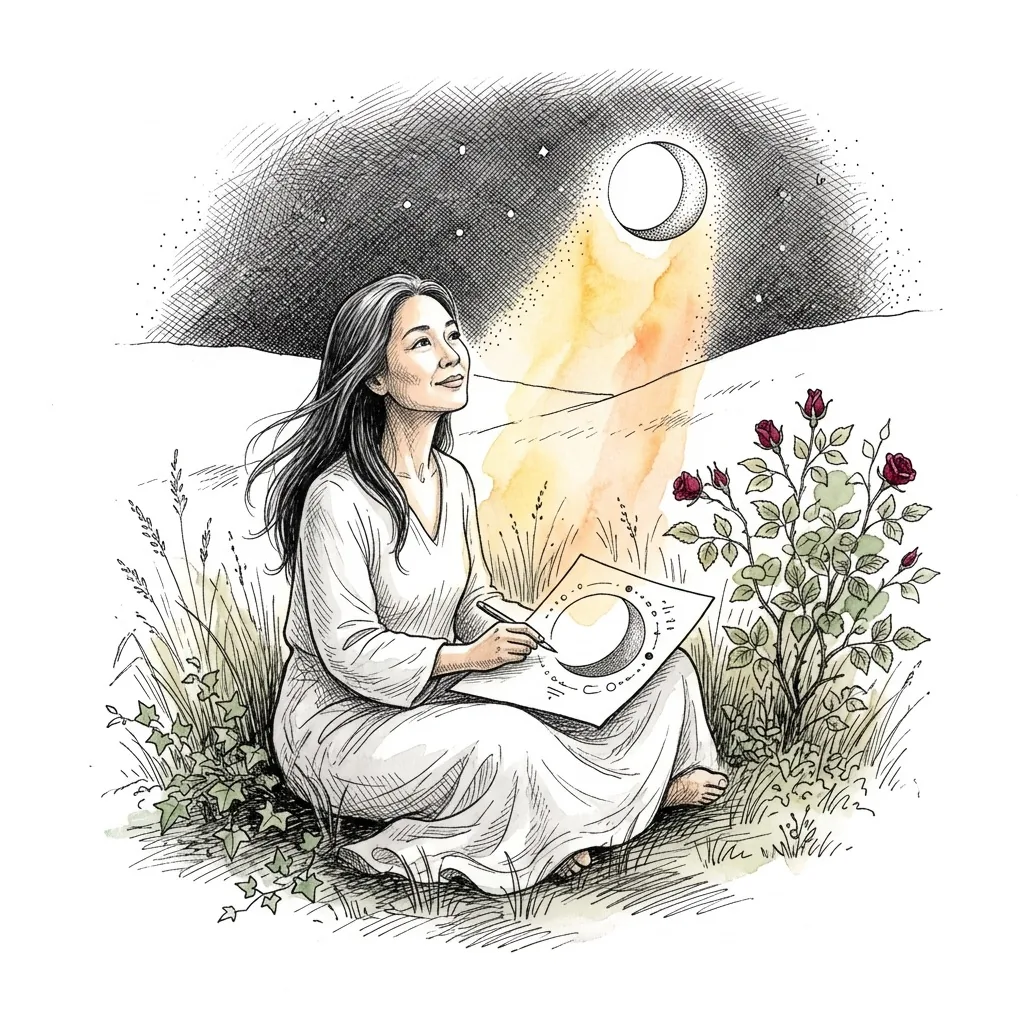
A simple paper practice for following the moon, and yourself
Dear one,
A moon journal is one of the oldest kinds of record there is. Long before calendars hung on walls, people counted time by the moon: marking her return, noticing how she changed, noticing how they changed alongside her.
You can keep one too, and you don’t need anything fancy to begin. Here’s what moon journaling is, how to set up a moon journal on paper in an evening, and what to track in each phase so that, after a few cycles, you start to see your own rhythm.
What is a moon journal?
A moon journal is a notebook organized around the phases of the moon rather than the weeks of the calendar. Each lunar cycle, from new moon to new moon, takes about 29.5 days, and your journal follows that cycle around and around.
There are three main kinds, and many women blend them:
- A moon observation journal records the moon herself: her shape, when and where you saw her, the weather, a quick sketch.
- A moon phase journal (or moon phases journal) records your inner life by phase: intentions at the new moon, reflections at the full, letting go as she wanes.
- A moon cycle journal tracks your menstrual cycle beside the moon’s, so you can see how your body’s seasons and the sky’s seasons meet.
You might also see a 13 moon journal. Some follow the full moons of the year (about twelve and a third lunar cycles fit into a year, so most years have twelve full moons, and every two or three years there’s a thirteenth). Others follow the 13 Moon calendar, which divides the year into thirteen months of 28 days. Either way, the idea is the same: living by the moon’s count rather than the office calendar’s.
Why keep a moon journal?
Moon journaling slows you down. Once or twice a week, it asks you to look up, look in, and write down what’s true.
Over time, it shows you patterns you would never notice day to day: the week you always feel restless, the phase when your creativity peaks, the days when everything feels too loud. That’s not magic. It’s attention, and attention is how self-knowledge grows.
How to set up a moon journal on paper
You need a notebook (lined, dotted or blank), a pen, and a moon calendar for the year. That’s it.
1. Make a moon map at the front
On the first page, list the dates of every new moon and full moon for the coming months. Any almanac or moon calendar will give you these. This is your map.
2. Give each lunar cycle a spread
Start a new two-page spread at each new moon.
The left page: your tracker. Draw a simple grid with one row for each day of the cycle (29 or 30 rows). Make a few narrow columns:
| Date | Moon | Cycle day | Energy (1 to 5) | Mood (one word) | Sleep | Notes |
|---|
In the Moon column, draw a tiny circle and shade it to match the phase: dark for new, half for the quarters, open for full. If you don’t bleed, leave Cycle day off, or count the new moon as Day 1.
The right page: your reflections. Divide it into four boxes: New, Waxing, Full, Waning. You’ll fill one each week.
3. Leave a page for the full moon
After each spread, leave one blank page. At the full moon, write freely, draw, or paste in a flower. This is your space for whatever doesn’t fit in a box.
4. Write little and often
A daily line in your tracker takes a minute. The reflection boxes take five to ten minutes a week. Consistency matters far more than length.
What to track in each moon phase
In The Womb Journal, each phase of the moon mirrors one of the four inner seasons. Here’s what to notice in each.
| Phase | Inner season | What to track | A question to ask |
|---|---|---|---|
| New moon | Winter (menstrual) | Energy, rest, what you’re releasing, one intention | What is my body asking me to release this cycle? |
| Waxing moon | Spring (follicular) | Rising energy, new ideas, first steps toward your intention | What do I want to call into this cycle? |
| Full moon | Summer (ovulatory) | What has bloomed, confidence, connection, what’s ready to go | What am I ready to celebrate about myself right now? |
| Waning moon | Autumn (luteal) | Irritations, cravings, boundaries, what to finish | What boundary have I been avoiding that I’m ready to finally set? |
If you’d like dozens more questions, see these New Moon and Full Moon Journal Prompts, arranged by phase.
Keeping a moon observation journal
If you love the sky, add a moon observation page to each spread. A few things to note:
- The date and time you saw her, and where she was in the sky.
- Her shape. Sketch it. You’ll start to recognize the crescent, the half moon, the gibbous moon and the full.
- The weather and the light. Was she hazy, golden, bright enough to cast shadows?
- How you felt looking at her.
You’ll quickly learn her habits. The full moon rises around sunset. The waxing moon is easiest to see in the evening, and the waning moon in the early morning. On average, she rises about fifty minutes later each day. Clouds don’t cancel the moon, so even “couldn’t see her tonight” is worth recording.
A few gentle tips
- Give it three cycles. One cycle is a moment; three is a pattern. This is why The Womb Journal guides you through three full cycles.
- Missed a week? Simply begin again at the next phase. The moon never scolds.
- Keep it private. A paper journal can’t be hacked, sold or breached. (Here’s why The Womb Journal lives on paper.)
- Bring it to your appointments. If you track your cycle, your notes are useful health information. If your periods become very irregular, very heavy or very painful, or change suddenly, please talk to your healthcare provider and bring your journal along.
If you’d like a ready-made page to start with, the Moon Cycle Tracker in our free Starter Kit lets you mark your bleed, your ovulation and the moon’s phases on a single sheet, with a filled-in example to show you how.
The Womb Journal: a guided moon journal that follows your cycle too
If you’d rather not draw your own grids, this is exactly why I made The Womb Journal. It’s a guided moon journal and a cycle journal in one, so you track the sky and your body side by side, without starting from a blank page.
Inside, you’ll find:
- Three cycles of guided daily pages, 93 days in all, each with a physical and emotional check-in, a spiritual practice page, and an open Creation Page to write, draw or dream
- A womb prompt and an affirmation for every day
- More than 30 rituals: one for each of the thirteen full moons, thirteen Womb Speaks rituals to connect with your womb, rituals for the new, waxing and waning moons, and ceremonies to honour the beginning and end of your bleed
- The four inner seasons, with nourishment, movement and self-care for each
- Charts to bring to your provider, including a moon cycle chart and a yearly period chart
And if you don’t bleed, the book invites you to let the moon lead: the new moon becomes your Winter, and you move through the seasons with her. Whether you bleed or follow the moon, there is no wrong way in.
If you’re in perimenopause and your cycle has begun to change, we’re also writing a volume for that season, with tracking made for it. You can join the waitlist at /books/.
Why do this on paper?
Your cycle, your rituals and your body’s story deserve better than an app that sells them. The Womb Journal lives on paper, on purpose: it can’t be hacked, sold or breached. What you write belongs to no one but you.
Begin tonight
Your free Womb Journal Starter Kit holds the Four Seasons at a Glance, a Moon Cycle Tracker, a Yearly Period Tracker to bring to your provider, the Homecoming ritual and the Womb Journal Vow. Print it and begin your practice tonight.
The Womb Journal is the whole path: three full cycles of guided daily pages, more than 30 rituals, and a womb prompt and affirmation for every day.
Held with care: this teaching is for reflection and self-knowledge. It isn’t medical advice. If something in your body worries you, please talk to your healthcare provider. Health disclaimer