
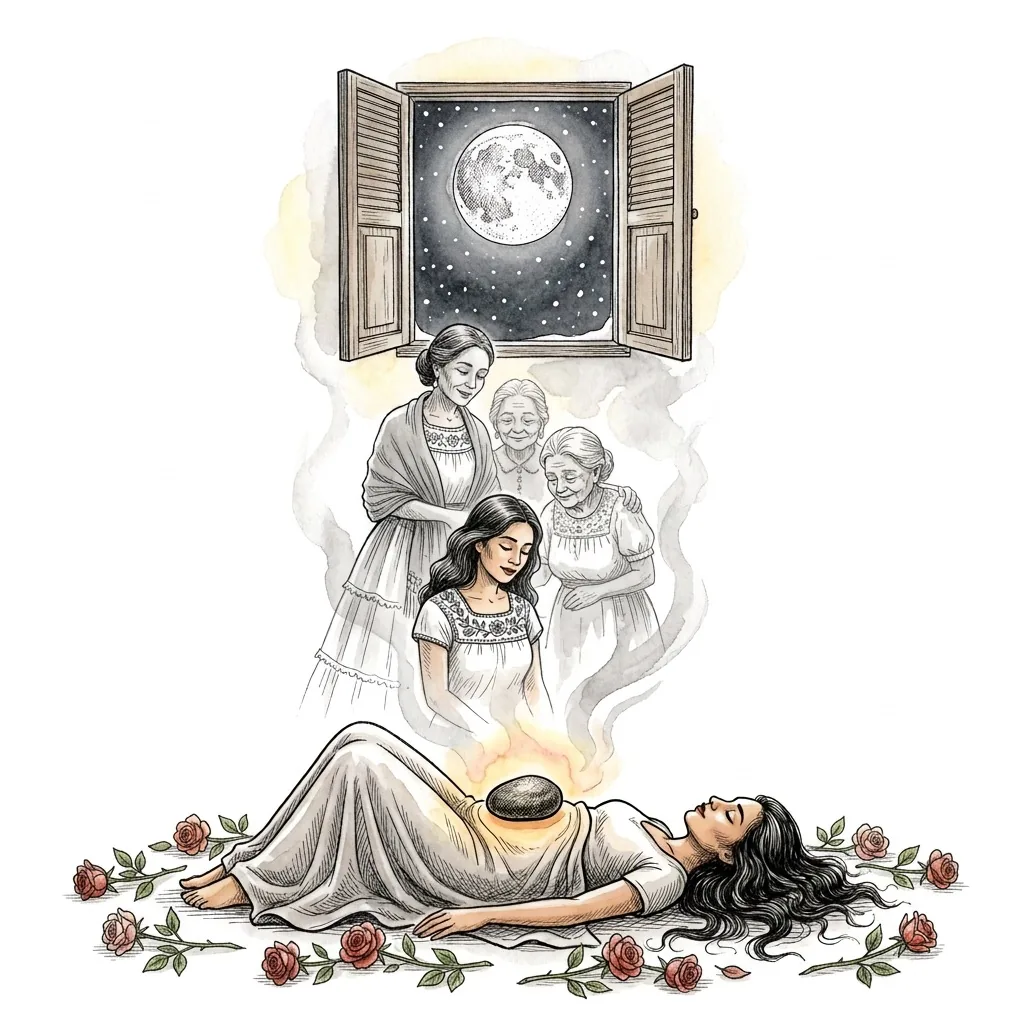
Coming home to the centre of your body, slowly and kindly
Dear one,
So many of us were taught to ignore the lower belly. To hold it in, to hide the bleed, to push through the cramps, to stay quiet about the losses. Over time, the womb space can start to feel like a stranger, or like a place that holds too much.
Womb healing is the practice of coming back. Not to fix your body, but to reconnect with it: to listen, to feel, and to make peace with the stories it carries. Here’s what womb healing is (and what it isn’t), and a gentle way to begin tonight.
What is womb healing?
Womb healing is an emotional and spiritual practice of reconnecting with your womb space: the lower belly and pelvis, the centre of so much of a woman’s experience. It’s about tending what lives there that isn’t physical:
- Grief: for pregnancies lost or never begun, for the body you had, for the mothering you did or didn’t receive.
- Shame: about blood, sex, desire, fertility, the size or shape of your belly.
- Trauma: experiences that left you feeling unsafe in your own body.
- Pleasure: the joy, sensuality and creative life force that often get buried along with the pain.
- Ancestral stories: what the women before you believed about their bodies, and what they passed on without meaning to.
You don’t need a womb to do this work. If you’ve had a hysterectomy, the womb space is still yours. The energy and the stories remain, and so does the invitation.
What womb healing is not
As a nurse, I need to be very clear here. Womb healing is not a medical treatment. It won’t cure fibroids, endometriosis, PCOS, infertility, pelvic pain or any other condition, and no one should promise you that it will.
If you have heavy bleeding, severe pain, pain during sex, bleeding between periods or after menopause, or concerns about your fertility, please see your healthcare provider. A pelvic floor physiotherapist can also help with many kinds of pelvic pain. Womb healing can sit beautifully alongside medical care. It is never a replacement for it.
What is womb wisdom?
Womb wisdom is the idea that your body knows things before your mind does. The tightness in your belly before you say yes to something you don’t want. The softening when you’re truly safe. The fatigue of your inner Winter asking you to rest.
In The Womb Journal, we listen to the body “as both science and sacred text.” That means taking your symptoms seriously, and also taking your inner knowing seriously. Both are information. Both deserve your attention.
Before you begin: a gentle note
Womb work can stir things up. Memories, tears, anger or numbness may surface, sometimes unexpectedly. That isn’t failure. It’s often a sign that something has been waiting to be felt.
Please go gently:
- Go slowly. A few breaths is enough for a first practice.
- It’s okay to stop. Open your eyes, move your hands, look around the room and name five things you can see. You can always come back another day.
- Keep your eyes open if you prefer. Rest your hands on your belly, or anywhere that feels safe, even your heart.
- You don’t have to do this alone. If you’ve experienced sexual trauma, birth trauma or pregnancy loss, a trauma-informed therapist can walk beside you. Reaching for support is part of healing, not a sign you’re doing it wrong.
The Homecoming: the first step in womb healing
This is the opening ritual of The Womb Journal, and it’s where I’d invite any woman to begin. It takes about ten minutes.
- Light a candle. Sit somewhere quiet. Put your phone in another room.
- Place both hands on your lower belly. Take ten slow breaths, letting each one sink down into your pelvis.
- Speak to your womb. Silently or aloud, say: “I see you. I’m here now. From this day on, I will listen.”
- Ask, and listen. How are you feeling? What do you need from me? What do you want me to know? Notice what comes: a word, an image, a sensation, a memory, or nothing at all. Nothing is also an answer.
- Write what you received. Then choose an anchor gesture, such as a hand on your womb, that you can return to anytime you want to reconnect.
- Close. Thank your womb. Take three breaths and blow out the candle.
The flame goes out, but the connection stays.
The full Homecoming is in our free Starter Kit, along with the Womb Journal Vow, so you can print it and keep it by your bed.
A womb healing meditation
Once you’ve done the Homecoming, you can return to this womb meditation whenever you need it. Allow ten to fifteen minutes.
- Settle. Lie down or sit comfortably. Rest your anchor gesture (your hand on your womb) in place.
- Breathe into the bowl. Imagine your pelvis as a bowl. With each inhale, let the breath fill it. With each exhale, let the bowl soften.
- Bring in warmth. Picture a gentle light or warmth in your womb space, in whatever colour feels kind. Let it grow a little with each breath.
- Notice what’s there. Is there tension, heaviness, emptiness, warmth? Don’t change it. Just say, “I see you.”
- Ask one question. What are you holding that you’re ready to set down? Or, if that feels like too much: What would feel good right now?
- Offer a blessing. This is a simple womb blessing you can use any day: “May you be safe. May you be honoured. May you be free of what is not yours to carry.”
- Return. Wiggle your fingers and toes. Open your eyes. Take a sip of water.
- Write three lines. What you felt, what you heard, and one small thing you’ll do for your body this week.
If at any point this womb healing meditation feels like too much, stop, open your eyes, and come back to the room. That’s wise, not weak.
How to heal your womb, day by day
People often ask me how to heal your womb, as if it’s a single event. It isn’t. It’s a relationship, and relationships grow through small, faithful acts:
- Check in daily. One hand on your belly, one breath, one question: What do you need today?
- Honour your seasons. Rest in your inner Winter. Let yourself shine in your Summer. (Read more in The Four Inner Seasons of Your Cycle.)
- Write the stories down. What did your mother teach you about periods? Your grandmother? What do you want to keep, and what ends with you?
- Reclaim pleasure. Warm baths, soft fabrics, dancing alone in the kitchen. Pleasure is a form of reconnection.
- Speak kindly to your body. Notice how you talk about your belly, and try one gentler sentence.
Some prompts to write with:
- What did I learn about my body as a girl that I no longer believe?
- Where in my body do I hold my grief?
- What does my womb want me to know right now?
- What story from the women in my family am I ready to release?
- What would it feel like to be fully at home in my body?
For more prompts like these, see Journal Prompts for Self-Love.
Thirteen Womb Speaks rituals
The Womb Journal was written for exactly this work. Alongside its rituals for the full, new, waxing and waning moons, it holds thirteen Womb Speaks rituals. There’s a womb prompt and an affirmation for every one of the 93 days, guidance on reading your bleed, and The Bleeding Ceremony.
If your womb story includes the long road of fertility treatment, we’re writing a fertility and IVF companion journal. Join the waitlist at /books/.
If you’ve been drawn to “womb cleansing” products online, please read Womb Cleansing: What to Really Expect first. And for the bigger picture of this work, see The Sacred Feminine.
You are coming home
Womb healing isn’t about becoming someone new. It’s about returning to who you were before the world taught you to leave your body behind. Go slowly. Be kind. Come back as often as you need.
I am the keeper of my body, my story, and my sovereignty.
Why do this on paper?
Your cycle, your rituals and your body’s story deserve better than an app that sells them. The Womb Journal lives on paper, on purpose: it can’t be hacked, sold or breached. What you write belongs to no one but you.
Begin tonight
Your free Womb Journal Starter Kit holds the Four Seasons at a Glance, a Moon Cycle Tracker, a Yearly Period Tracker to bring to your provider, the Homecoming ritual and the Womb Journal Vow. Print it and begin your practice tonight.
The Womb Journal is the whole path: three full cycles of guided daily pages, more than 30 rituals, and a womb prompt and affirmation for every day.
Held with care: this teaching is for reflection and self-knowledge. It isn’t medical advice. If something in your body worries you, please talk to your healthcare provider. Health disclaimer