What it means when you bleed with the full moon, the new moon, or somewhere in between
Dear one,
Have you ever noticed that your period seems to arrive with the full moon? Or that it keeps landing on the dark new moon? You’re not imagining a connection. Women have been watching the moon and their bodies side by side for as long as there have been women.
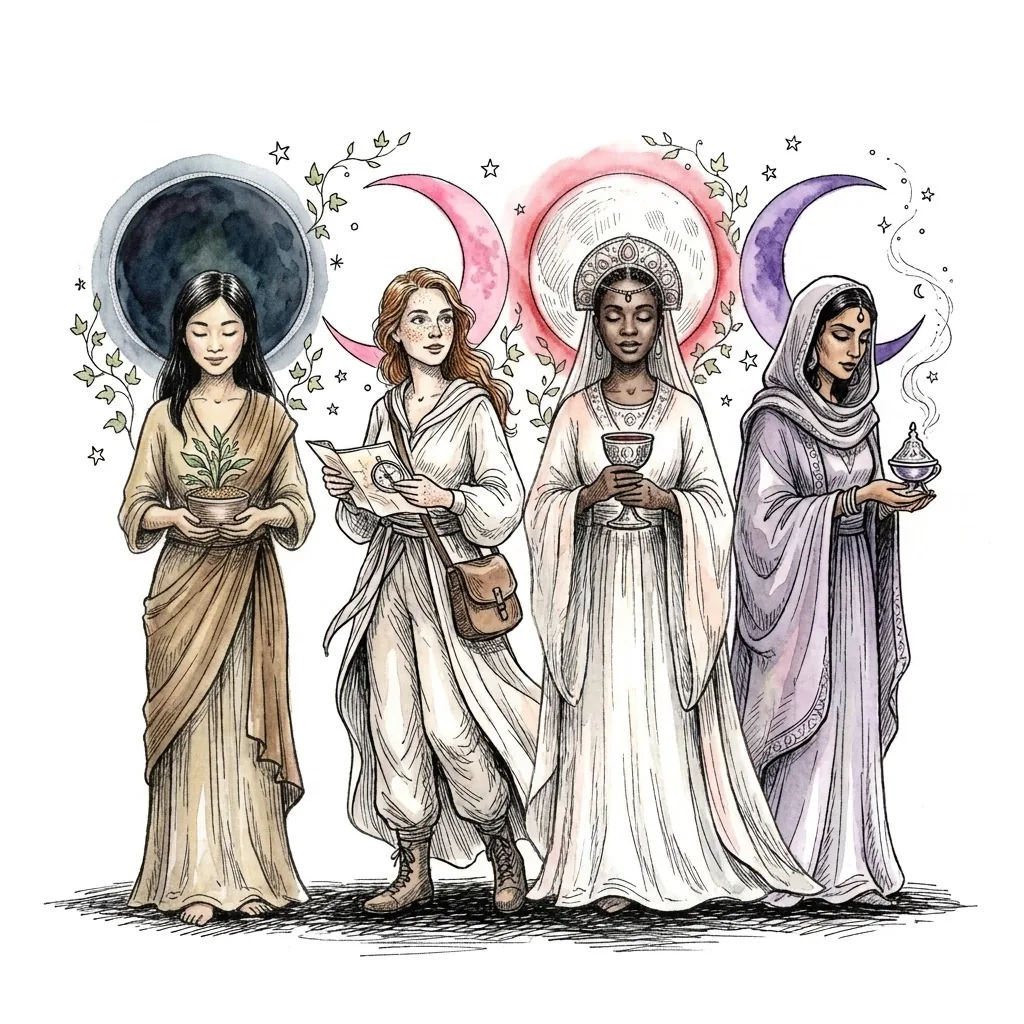
In the language of moon wisdom, these patterns have names: the White Moon cycle and the Red Moon cycle, with the Pink Moon and Purple Moon in between. Here’s what each one means, what science says (as a nurse, I care about both), and how to discover your own.
The basics: your cycle and the moon’s
The moon moves from new to full and back again in about 29.5 days. Many women’s cycles run somewhere between 21 and 35 days, often close to the moon’s. The word “menstruation” even shares its root with the Latin and Greek words for month and moon.
So in any given month, your bleed will fall somewhere in the moon’s cycle. Where it falls is what these traditions read.
The White Moon cycle: bleeding with the new moon
When: you bleed around the new moon and ovulate around the full moon.
The meaning: this is often considered the most “traditional” pattern: your body’s fertility peaks as the moon’s light peaks. The White Moon cycle is associated with nurturing, fertility, receptivity and turning inward during your bleed, when the sky is darkest.
In The Womb Journal’s language, your inner seasons line up exactly with the moon’s:
- Winter (your bleed) falls at the dark new moon
- Spring rises with the waxing moon
- Summer (ovulation) blooms with the full moon
- Autumn softens with the waning moon
If this is you, the moon and your body are walking together. Rest in the dark, shine in the light.
The Red Moon cycle: bleeding with the full moon
When: you bleed around the full moon and ovulate around the new moon.
The meaning: in moon wisdom, the Red Moon cycle has long been linked with the healer, the wise woman, the creative and the medicine woman. Instead of pouring her energy outward into fertility at the full moon, a Red Moon woman turns it inward during the moon’s brightest time, toward intuition, creativity, insight and healing others.
Some women find this cycle arrives during seasons of big personal change, intense creative work, or when they’re focused on something other than conceiving.
There is nothing wrong with a Red Moon cycle. It’s not “out of sync”. It’s a different rhythm, and it holds its own power.
The Pink Moon and Purple Moon cycles
Not every cycle lands neatly on a new or full moon. The in-between patterns have names too:
- Pink Moon cycle: you bleed during the waxing moon (between new and full). Often described as a time of transition: moving from inward focus toward outward expression, or from one life chapter into the next.
- Purple Moon cycle: you bleed during the waning moon (between full and new). Often described as a time of letting go, deep inner work and spiritual transformation.
Do cycles really sync with the moon? What the science says
I want to be honest with you here, because you deserve both the poetry and the facts.
The large studies say: on average, no. When researchers have looked at millions of cycles logged in period-tracking apps, they haven’t found that women in general tend to bleed at the full or new moon.
But some long-term studies of individual women say: sometimes, yes. A 2021 study in Science Advances followed women who had kept their own cycle records for up to 32 years. It found that some women’s cycles synchronized with the moon for stretches of time, especially when they were younger, and that this synchrony seemed to weaken with artificial light at night and with age.
So the truth may be this: the moon doesn’t control your cycle, but your body may sometimes fall into step with her, the way you fall into step with someone you walk beside. Artificial light, stress, travel and hormones all influence whether that happens.
What science can’t measure is meaning. Whether your cycle is biologically pulled by the moon or not, choosing to notice the moon alongside your body is a powerful practice. It slows you down. It connects you to a rhythm older than any calendar. And it gives you a monthly mirror for your inner seasons.
Can your moon cycle change?
Yes, and it usually does. Very few women bleed at the same moon phase for years on end. Your cycle may drift from White to Pink to Red to Purple and back as your life changes.
Many women notice their cycle shifting during:
- big life transitions (a move, a new job, a loss, a new love)
- seasons of intense creative or caregiving work
- stress, illness or travel
- changes in sleep and light exposure
- the Maiden, Queen, Mother, Healer and Wise Woman transitions (more in The Five Faces of a Woman’s Life)
Some women find they can gently encourage their cycle toward the White Moon by sleeping in true darkness and getting more natural light during the day. There’s not much research on this, but darkness at night is good for your sleep regardless.
What if you don’t bleed?
You can still live by the moon. If you’re on hormonal contraception, pregnant, postpartum, in perimenopause or menopause, or have had a hysterectomy, the Womb Journal invites you to let the moon be your cycle: your Day 1 is the new moon, and you move through the four inner seasons with her phases.
Whether you bleed or follow the moon, your rhythm belongs to you.
How to find your moon cycle
You only need two things: the dates of your bleed, and a moon calendar.
- Mark Day 1 of your bleed (the first day of real flow, not spotting).
- Look up the moon phase on that date in any moon calendar or almanac.
- Note it: new (White), waxing (Pink), full (Red) or waning (Purple).
- Repeat for three cycles. One cycle is a moment; three cycles is a pattern. This is why The Womb Journal guides you through three full cycles of daily pages.
- Notice how you feel. Does your energy, mood or intuition change with your moon cycle? Write it down.
The free Moon Cycle Tracker in our Starter Kit lets you mark your bleed, your ovulation and the moon’s phases on one page, with a filled-in example to show you how. You can print it tonight.
Important: a moon cycle is not a diagnosis. If your periods are very irregular, very heavy, very painful, or suddenly change, please talk to your healthcare provider. The Womb Journal’s yearly period chart is designed to bring to that appointment.
Your bleed is a message
Whatever moon you bleed under, your bleed has something to tell you. The Womb Journal includes a full section on reading your bleed, the Bleeding Ceremony, and a ritual for every full moon of the year, so you can meet each phase with intention.
Why do this on paper?
Your cycle, your rituals and your body’s story deserve better than an app that sells them. The Womb Journal lives on paper, on purpose: it can’t be hacked, sold or breached. What you write belongs to no one but you.
Begin tonight
Your free Womb Journal Starter Kit holds the Four Seasons at a Glance, a Moon Cycle Tracker, a Yearly Period Tracker to bring to your provider, the Homecoming ritual and the Womb Journal Vow. Print it and begin your practice tonight.
The Womb Journal is the whole path: three full cycles of guided daily pages, more than 30 rituals, and a womb prompt and affirmation for every day.
Held with care: this teaching is for reflection and self-knowledge. It isn’t medical advice. If something in your body worries you, please talk to your healthcare provider. Health disclaimer