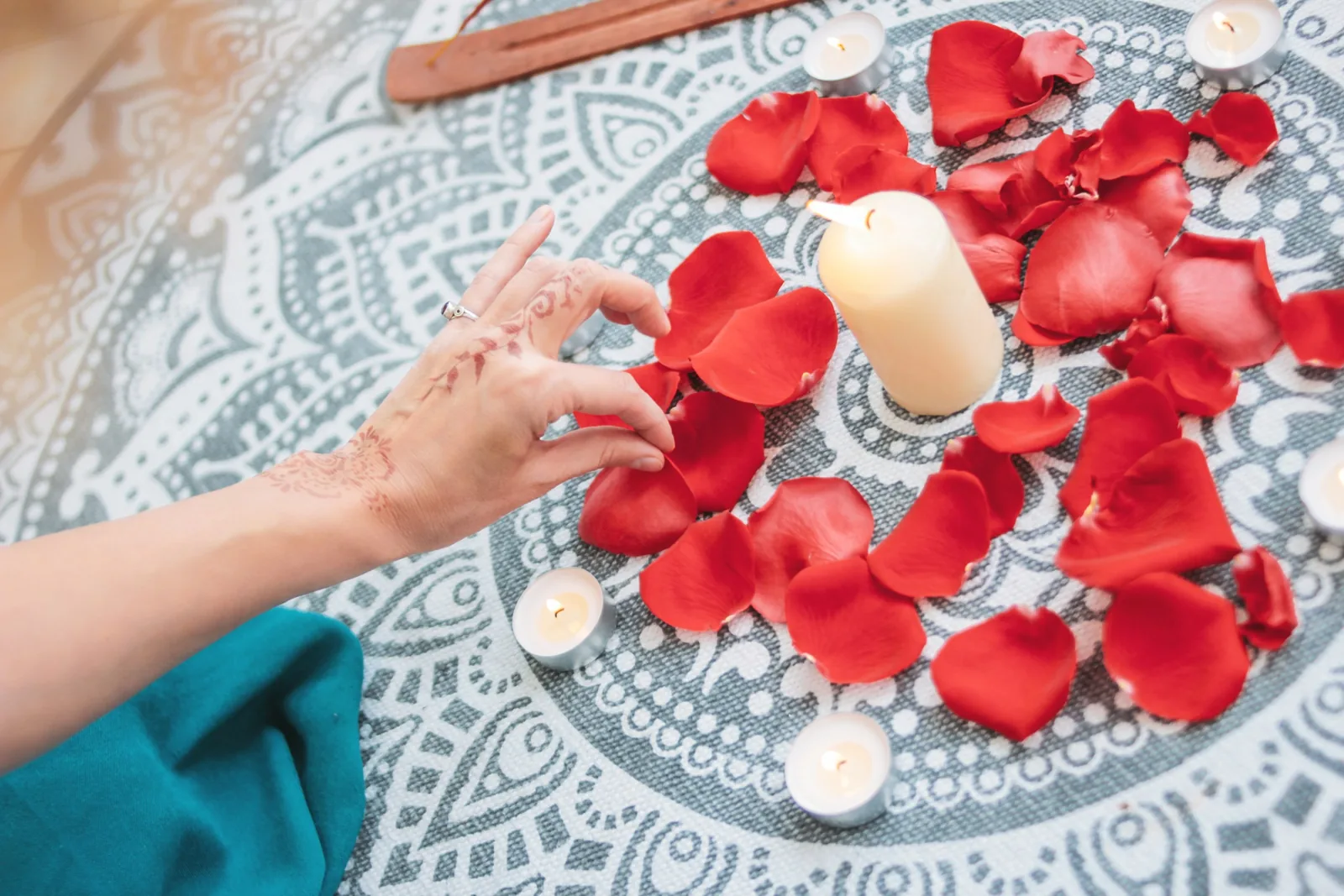
Some nights call for full priestess mode: the moon overhead, candles lit, your altar dressed with roses, crystals and the sacred things you love. Those ceremonies are beautiful, and we hope you make time for them, especially at the new and full moon. But life won’t always give you an hour of candlelight, and you don’t have to wait for it. As The Womb Journal says, every day, every moment, can be made into a beautiful ritual.
When we hear the word ritual, many of us picture something grand: candles in a circle, a ceremony under the full moon, words spoken in a hushed room. Those rituals are beautiful, and they have their place. But the most powerful rituals in a woman’s life are often the smallest ones, repeated quietly, day after day.
In The Womb Journal, every daily page carries a simple line: every day, every moment, can be made into a beautiful ritual. It is one of the truest things I know.
Moon rituals and everyday rituals: you need both
Your moon rituals are the great ceremonies of your month. On the new moon you plant your intentions; on the full moon you celebrate and release. Bring out everything that makes it feel sacred to you: your altar cloth, candles, crystals, oils, roses, a beautiful journal, your favourite music. Let it be an occasion.
Everyday rituals are the thread that runs between them. They keep you connected to your body and your intentions on the busy days, the tired days and the days when there’s no time to light a single candle. The moon gives your practice its rhythm; the small moments keep it alive.
What makes something a ritual?
A ritual is not defined by what you do. It is defined by how you do it. Washing your hands, pouring your tea or stepping through your front door can be done on autopilot, or with intention. The action stays the same. Your presence is what changes.
A routine is something you get through. A ritual is something you arrive in.
When you bring your full attention to an ordinary moment, you send yourself a quiet message: I am here. This moment matters. I matter. Over time, those small messages add up to something profound: a relationship with yourself.
Why small rituals matter
As a nurse, I have watched what constant rushing does to the body: the shallow breath, the tight shoulders, the sense of living a few steps ahead of yourself. As a mystic, I have seen what happens when a woman slows down long enough to come home to her body. She softens. She listens. She remembers.
Research is beginning to catch up with what women have always known. Researchers who study ritual, including a team at Harvard Business School, have found that performing a simple ritual before a stressful task can lower anxiety, and that a small ritual before eating can make food more enjoyable and more fully savoured. A ritual doesn’t have to be ancient or complicated to work. It only has to be yours, and done with intention.
Small rituals also take almost no time. You don’t need to find an extra hour in your day. You only need to change the way you meet the moments you already have.
Simple rituals for an ordinary day
Here are a few ways to turn everyday moments into a practice of coming home to yourself. Choose one. Let it become yours before you add another.
- The first glass of water. Before your phone, before your coffee, hold a glass of water in both hands. Take three slow breaths. As you drink, imagine it reaching every cell of your body, waking you gently into the day.
- The tea ritual. Make your tea or coffee without doing anything else. Watch the steam rise. Wrap your hands around the cup and feel its warmth. Let the first sip be a small act of devotion to yourself.
- The threshold pause. Each time you walk through your front door, pause for one breath. Leave the outside world at the door, and arrive fully home.
- The shower blessing. Let the water wash away what you no longer need to carry. Silently name one thing you are releasing as it runs down the drain.
- Hands on your womb. At any moment of the day, rest one hand on your lower belly. Breathe into it. Ask: What do you need right now? Listen without judgement.
- Candlelight at dinner. Light a candle before you eat, even if you’re alone, even if it’s leftovers. You are worthy of candlelight.
- Look for the moon. Each evening, step outside or look out a window to find the moon. Notice her phase. Let her remind you that you, too, move in cycles.
- Closing the day. Before sleep, place your hands on your heart and your womb. Name three things you are grateful for, and one thing you are proud of.
How to turn any moment into a ritual
If you want to create your own, use these three simple steps:
- Pause. Stop for a moment before you begin. Take one full, slow breath.
- Intend. Silently name what this moment is for: I drink this water to nourish myself. I light this candle to welcome rest.
- Notice. Bring your senses into it. What do you see, hear, smell, feel? Stay with the experience instead of rushing to the next thing.
That’s it. Pause, intend, notice. Any moment can hold it.
Ritual is a way back to yourself
Every woman deserves to feel at home in her own body. For many of us, that homecoming doesn’t arrive in one dramatic moment. It arrives slowly, through a thousand small returns: a breath before a meal, a hand on the belly, a glance at the moon.
On the nights you can, go into full priestess mode under the moon. On the days you can’t, the ritual is already here, waiting in the ordinary moments. All it asks is that you show up for it.
Begin with one moment today, and let it be enough.
Want a place to begin? The free Womb Journal Starter Kit includes The Homecoming, a simple ritual to reconnect with your womb, and a tracker to follow your cycle beside the moon. Join the Rose Circle to receive it.
Read next: The Sacred Feminine: Coming Home to Your Body
Sources: Brooks, A. W., et al. (2016). Don’t stop believing: Rituals improve performance by decreasing anxiety. Organizational Behavior and Human Decision Processes, 137, 71–85. Vohs, K. D., Wang, Y., Gino, F., & Norton, M. I. (2013). Rituals enhance consumption. Psychological Science, 24(9), 1714–1721.
Held with care: this teaching is for reflection and self-knowledge. It isn’t medical advice. If something in your body worries you, please talk to your healthcare provider. Health disclaimer